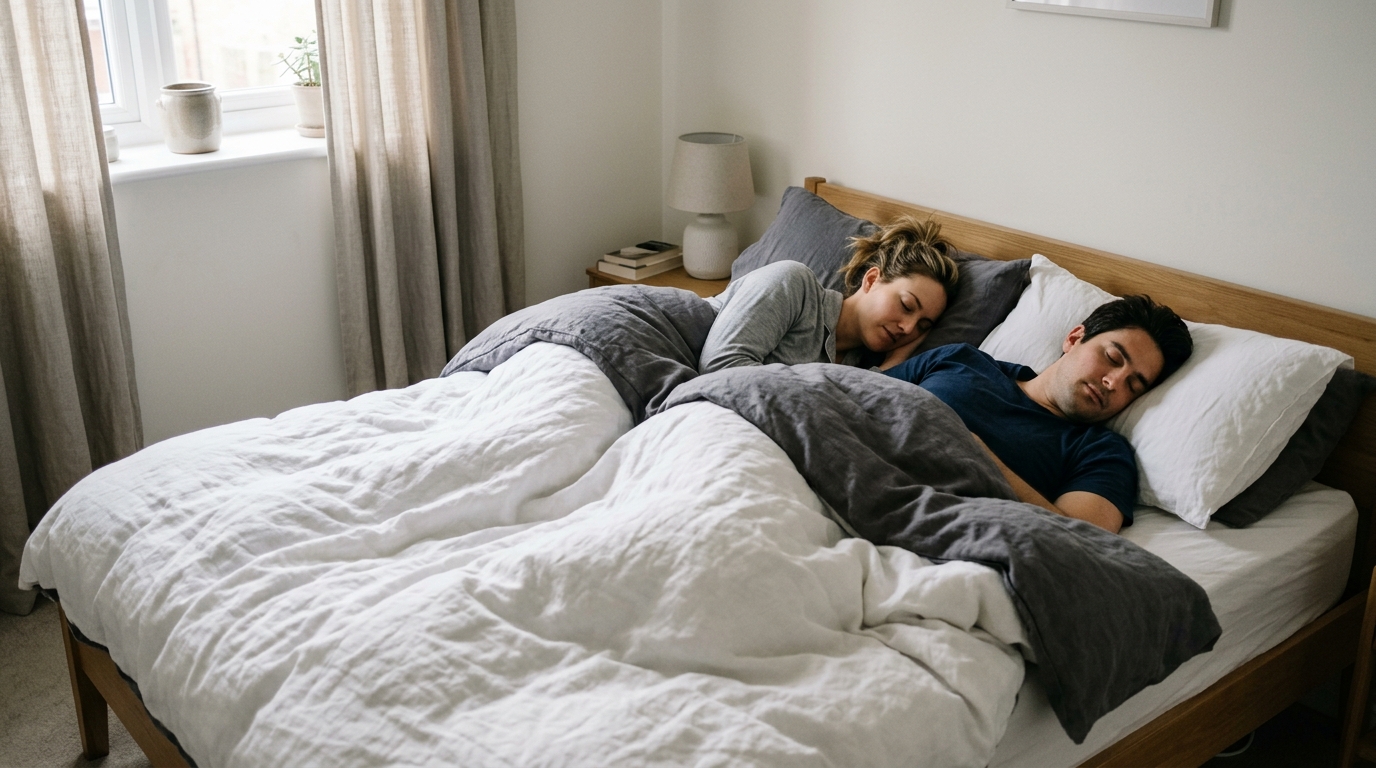
A few years ago almost nobody said “sleep divorce”. Now it’s everywhere, and the numbers explain why. The National Bed Federation reports UK searches for the term up around 86%, and snoring is the reason couples give most often for sleeping apart. Moving into the spare room is a big step, though, for a problem that usually has a much smaller answer. So we spent six weeks hunting for a sleep divorce alternative that lets two people stay in the same bed, testing the products and habits couples reach for when one person’s snoring is wrecking the other’s sleep. Each option got marked on how well it blocked noise in real use, how comfortable it was for side sleepers, whether you could still hear your alarm, and what it costs you over time.
Tested over 30+ nights by a panel of light sleepers and snoring couples, scored on noise reduction, side-sleeper comfort, alarm audibility, and long-term value.
[/ux_text] [/col] [/row] [/section] [section id=”product-1″ padding=”24px 0px 24px 0px” padding__sm=”16px 0px 16px 0px” bg_color=”rgb(245, 248, 255)”] [row v_align=”middle” h_align=”center”] [col span=”4″ span__sm=”12″ force_first=”small” align=”center”] [ux_image id=”4686″ image_size=”original” link=”https://bollsen-hearingprotection.com/product/life/” target=”_blank”] [/col] [col span=”8″ span__sm=”12″] [ux_text font_size=”1.1″]BOLLSEN Life+ Earplugs
★ Our Top Pick — Best overall · side sleepers · snoring partners
If you want to dodge a sleep divorce without anyone leaving the bedroom, this is where we landed. BOLLSEN is a hearing protection specialist, and its products are independently tested and certified in Germany. The Life+ is made to dampen the low rumble of snoring while still letting the high pitch of an alarm through. Its low-profile fit means side sleepers can lie on the pillow with nothing poking into the ear.
[/ux_text] [block id=”2889″] [ux_text font_size=”1.02″]- Certified 24 dB low-frequency noise reduction, independently tested in Germany
- Low-profile flush fit designed for side sleepers, no pressure on the pillow
- Still passes high-frequency sound, so you hear your alarm and smoke detector
- Reusable up to 100 times, washable, with an aluminium travel case
- More expensive upfront than a bag of disposable foam plugs
- Takes a night or two to get used to sleeping with anything in your ears
Why It’s Our Top Pick
Snoring is loud. A heavy snorer sits around 45 to 55 decibels, roughly the sound of steady rain a few inches from your ear, and it goes on all night. Foam plugs muffle some of that, but they block your alarm too, they work loose, and they flatten out within a week. The Life+ behaved differently in our testing. It brought the snoring down to a soft, distant hum the panel slept through, and every tester still woke to their phone alarm in the morning. That combination is the whole point for couples deciding whether to split the bedroom. You get your sleep back without giving up the bed.
The side-sleeper fit is what set it apart. Most of our panel sleep on their side, and the flat conical shape sits flush in the ear, so nothing digs into your head when your face is pressed into the pillow. That sounds like a small thing until you have spent a night with a chunky foam plug pushing back against your own pillow.
Key Specifications
The Life+ uses a patented two-lamella conical design moulded from medical-grade silicone, and it carries a certified 24 dB rating from independent German testing (PZT GmbH, NANDO-listed Notified Body 1974, patent US D961,757). The filtering is the clever bit. It blocks low-frequency noise like snoring and traffic, while higher-frequency sound like an alarm or a smoke detector still comes through. Each pair lasts up to 100 uses, rinses clean under the tap, and comes in a slim aluminium case that suits a nightstand or a suitcase. The silicone is BPA-free, PVC-free, and latex-free.
Not sure about sizing? BOLLSEN offers AR KI TECH, an AI fitting service where you upload two photos of your ears and it works out the right size for you. That sort of detail is why their return rate sits at around 3%.
Expert Verdict
For the one job of keeping a couple in the same bed when one of them snores, the Life+ was the clearest answer we tested. It has over 10,000 verified reviews behind it, more than 1,000,000 people use it worldwide, and BOLLSEN has been featured in BBC Science Focus, Which?, and Glamour UK. The 40-day money-back guarantee lets you try it over a few weeks of real nights and send it back if it does not fix your sleep. Set against the cost and the emotional weight of moving into separate rooms, it is an easy thing to try first.
[/ux_text] [/col] [/row] [/section] [divider margin=”0px”] [section bg_color=”rgb(0, 36, 125)” padding=”24px 0px 24px 0px”] [row h_align=”center”] [col span__sm=”12″ align=”center”] [ux_text font_size=”1.05″]Ready to stay in the same bed and still get a full night’s sleep?
[/ux_text] [button text=”Try Risk-Free — 40-Day Guarantee” color=”secondary” style=”shade” size=”large” radius=”10″ link=”https://bollsen-hearingprotection.com/product/life/” target=”_blank”] [/col] [/row] [/section] [divider margin=”0px”] [section id=”product-2″ padding=”24px 0px 24px 0px” padding__sm=”16px 0px 16px 0px”] [row v_align=”middle” h_align=”center”] [col span=”3″ span__sm=”12″ force_first=”small” align=”center”] [ux_image id=”4687″ image_size=”original”] [/col] [col span=”9″ span__sm=”12″] [ux_text font_size=”1.05″]Disposable Foam Earplugs
Best for: cheapest short-term fix
The first thing most people try. Foam plugs expand to fill the ear canal and they really do block a lot of noise, snoring included. They are cheap and you can buy them anywhere. The problems show up after a few nights. They block your alarm just as well as they block your partner, they work loose if you sleep on your side, and the foam wears out fast, so you are buying more every week.
- Very cheap and available in any pharmacy or supermarket
- High raw noise blocking when freshly inserted
- Blocks your alarm along with the snoring
- Single-use foam degrades quickly and ends up in landfill
- Bulky in the ear and uncomfortable for side sleepers
White Noise Machine
Best for: masking, not blocking
A white noise machine does not stop the snoring. It covers it with a steady wash of sound your brain learns to ignore. For lighter, more rhythmic snoring it can work well, and there is nothing in your ears, which some people much prefer. The catch is that heavy or irregular snoring tends to spike above the masking sound, and the machine fills the room for your partner too, so it is not always a one-sided fix.
- Nothing in your ears, no fit or comfort issues
- Can help with general sleep, not just snoring
- Masks rather than blocks, so loud snoring still breaks through
- Adds a constant sound to the room your partner also has to accept
Anti-Snore Mouthpiece
Best for: treating the snorer
This one goes after the source rather than the listener. A mandibular advancement device holds the snorer’s lower jaw slightly forward to keep the airway open, which can cut or stop the noise where it starts. When it works, both people benefit. The downside is that the snorer has to wear it every night, fit and comfort vary a lot from person to person, and it does nothing for snoring that comes from congestion or alcohol rather than jaw position.
- Can address the snoring at the source rather than masking it
- Benefits both partners when it works
- Requires the snorer to wear a device in their mouth all night
- Comfort and effectiveness vary widely, and not all snoring responds
Sleeping in Separate Rooms (the Sleep Divorce Itself)
Best for: a last resort
The option that named the whole trend. Moving to the spare room does fix the noise completely, and plenty of couples say they sleep better for it, so it earns an honest place on this list. What you give up is the catch. You lose the shared wind-down at the end of the day and the easy closeness of the same bed, and for a lot of couples that loss is the very reason they wanted a smaller fix in the first place. We put it last for that reason, worth trying after the in-bed options rather than before them.
- Completely removes the noise, no device or earplug needed
- Some couples genuinely sleep better with their own space
- Loses the shared bedtime and closeness that many couples value
- Requires a spare room, which not every home has
Frequently Asked Questions
What is a sleep divorce and is it healthy?
A sleep divorce is when a couple decides to sleep in separate beds or separate rooms, usually because one partner’s snoring, movement, or schedule keeps the other awake. It is not a relationship breakup, just a sleeping arrangement. For some couples it works well and both people sleep better. For others, the lost bedtime together matters more than the extra sleep, which is why many look for a way to stay in the same bed first.
How common is sleep divorce in the UK?
It is rising fast. The National Bed Federation reports UK searches for the term up around 86%, and survey data suggests roughly one in six couples now sleep apart at least some of the time. Snoring comes up again and again as the single biggest reason.
Can earplugs really block out a partner’s snoring?
Yes, the right ones can. Snoring is mostly low-frequency sound, and that is exactly the range good earplugs are built to dampen. In our testing the certified 24 dB Life+ brought a heavy snore down to a faint, distant hum our panel slept straight through. Cheap foam plugs block sound too, but they muffle your alarm and lose their shape within days.
Do you still hear your alarm if you sleep with earplugs in?
With the Life+, yes. Its filter lets high-frequency sound through while blocking the low rumble of snoring, so an alarm or a smoke detector still reaches you. Foam earplugs work differently. They block sound across the board, which is why so many people sleep through their alarm with them in.
How many decibels do earplugs need to block to stop snoring?
A heavy snore measures roughly 45 to 55 decibels. You do not have to block all of it to sleep. You just need to bring it below the point where it pulls you awake. A certified 24 dB reduction, the kind the Life+ gives you, is enough to turn that snore into soft background sound for most people.
Is sleeping in separate beds bad for a relationship?
Not by itself. Plenty of happy couples sleep apart and feel closer for being properly rested. It really depends on what each partner values. If the shared bed matters to you, try the in-bed fixes first, such as earplugs, a white noise machine, or an anti-snore device, before you move to separate rooms.
[/ux_text] [/col] [/row] [/section] [section bg_color=”rgb(245, 248, 255)” padding=”24px 0px 24px 0px” padding__sm=”16px 0px 16px 0px”] [row h_align=”center”] [col span__sm=”12″] [ux_text]