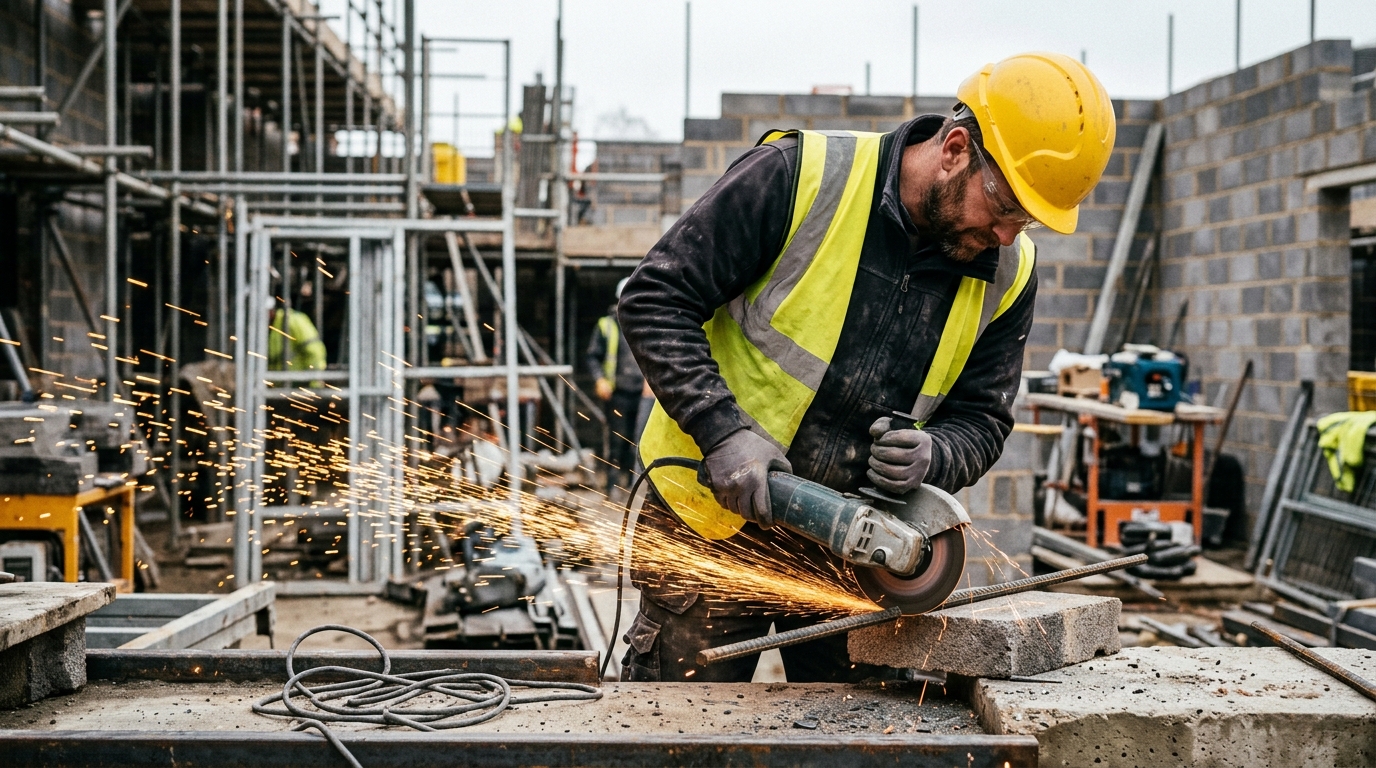
One in four construction workers who spend their days around loud tools ends up with some degree of hearing damage. Most never see it coming. It does not arrive as a sudden bang. It creeps in over years of grinders, breakers, and nail guns until one day the telly is too quiet for you but too loud for everyone else. Nearly all of it is preventable, and getting the right hearing protection for construction workers takes a few minutes once you understand the rules and what to look for. This guide walks you through when you actually need it, what the law says, and how to pick protection you will genuinely wear all day.
[/ux_text] [/col] [/row] [/section] [section id=”product-1″ padding=”24px 0px 24px 0px” padding__sm=”16px 0px 16px 0px” bg_color=”rgb(245, 248, 255)”] [row v_align=”middle” h_align=”center”] [col span=”4″ span__sm=”12″ force_first=”small” align=”center”] [ux_image id=”4697″ image_size=”original” link=”https://bollsen-hearingprotection.com/product/work-pro/” target=”_blank”] [/col] [col span=”8″ span__sm=”12″] [ux_text font_size=”1.1″]BOLLSEN WorkPRO Earplugs
★ Our Top Pick — site work and trades
BOLLSEN is a hearing protection specialist whose earplugs are independently tested and certified in Germany. WorkPRO uses a flat filter instead of foam, so it knocks down the dangerous edge of tool noise while you can still hear a mate calling across the site or a reversing alarm behind you. The medical-grade silicone is reusable up to 100 times and washable, and it is certified to cut noise by 24 dB. That makes it a sensible all-day choice for builders and tradespeople.
[/ux_text] [block id=”4539″] [ux_text font_size=”1.02″]- Certified 24 dB noise reduction, independently tested in Germany
- Flat filter keeps speech and warnings clear instead of muffling everything
- Reusable up to 100 times, washable, comes with a travel case
- Comfortable enough to wear through a full shift
- Backed by a 40-day money-back guarantee
- Costs more upfront than a box of disposable foam plugs
Work out whether your site is actually too loud
Before you do anything else, get a feel for the noise you are dealing with. A rough rule that surveyors use: if you have to raise your voice to talk to someone two metres away, you are probably above 85 dB and your hearing is at risk. Construction sites are full of tools that blow past that line without much fuss.
Here is roughly where common kit sits. An angle grinder runs around 95 to 100 dB. A breaker or jackhammer pushes 100 to 110 dB. A nail gun fires at about 110 dB, a circular saw sits near 100 dB, and even a fairly tame impact driver can hit the high 90s. Power tool noise levels in dB matter because the scale is not linear. Every 3 dB rise roughly doubles the sound energy hitting your ear, so the gap between a 91 dB tool and a 100 dB one is far bigger than it sounds.
Know the Control of Noise at Work Regulations 2005 thresholds
UK law sets clear trigger points under the Control of Noise at Work Regulations 2005, and they are worth committing to memory. The lower action value is 80 dB averaged over the day. At that point your employer has to assess the risk and make hearing protection available if you ask for it. The upper action value is 85 dB. Once daily noise crosses that line, protection is mandatory and the area should be marked as a hearing protection zone. There is also a hard ceiling, the exposure limit value, at 87 dB measured inside the protection, which you must never exceed.
In plain terms, this is when you need hearing protection at work: if a normal day on your site averages 85 dB or more, you wear it, full stop. And since a single hour on the breaker can drag your daily average above that line, most people in noisy trades are well into mandatory territory long before the shift ends.
Sort out who is responsible, including the self-employed
If you are an employee, the duty sits with your employer. They have to assess noise, supply suitable protection, mark out the zones, and train you on how to use the kit. That is settled ground.
The self-employed picture trips a lot of people up. If you are a self-employed tradesperson, the law still expects you to protect your own hearing, and you carry the responsibility yourself. No site manager is going to hand you a pair of plugs and remind you to wear them. Subcontractors and one-person bands are exactly the group the figures show going deaf, partly because nobody is watching and partly because protection feels like an optional extra. It is not. If you work for yourself around noise, your hearing is your own asset to look after.
Choose the right type: earplugs or ear defenders
People often ask whether earplugs or ear defenders are better for construction work, and the honest answer is that it depends on the job. Ear defenders sit over the ear and are quick to throw on and off, which suits short bursts of very loud work. They get hot and bulky under a hard hat in summer, and they clash with glasses and visors.
Earplugs win for all-day wear. They sit under any helmet, stay cool, and do not fight with your other PPE. The catch is the type of plug. Cheap disposable foam blocks everything equally, so you lose speech and warnings along with the danger, which is exactly why so many lads pull them out to talk and then forget to put them back in. Filtered or high-fidelity earplugs fix that. They use a flat filter that drops the overall volume while keeping speech and site sounds clear, so reusable earplugs for tradesmen tend to stay in your ears rather than your pocket. That is where something like the WorkPRO comes in.
Ditch the “I’m used to it” mindset for good
This one is worth saying straight. Getting used to the noise is not your ears toughening up. It is the early stage of noise induced hearing loss in construction, where the cells that pick up certain frequencies have already started to die off, so the racket simply does not register the way it used to. You are not adapting. You are losing range, quietly and permanently.
Tinnitus from work noise often shows up first, that constant ringing or hissing that will not switch off, especially at night when the site is finally quiet. Around 7% of noise-exposed construction workers report it. Once it sets in, there is no cure, only management. Industrial deafness in the UK is one of the most common occupational illnesses precisely because the damage is invisible until it is done. The only real defence is to protect your hearing every single noisy day, before you can tell anything is wrong.
[/ux_text] [/col] [/row] [/section] [section bg_color=”rgb(0, 36, 125)” padding=”24px 0px 24px 0px”] [row h_align=”center”] [col span__sm=”12″ align=”center”] [ux_text font_size=”1.05″]Ready to protect your hearing without losing track of what is happening on site?
[/ux_text] [button text=”Try Risk-Free — 40-Day Guarantee” color=”secondary” style=”shade” size=”large” radius=”10″ link=”https://bollsen-hearingprotection.com/product/work-pro/” target=”_blank”] [/col] [/row] [/section] [divider margin=”0px”] [section padding=”30px 0px 30px 0px” padding__sm=”20px 0px 20px 0px”] [row h_align=”center”] [col span__sm=”12″] [ux_text font_size=”1.05″ line_height=”1.7″]Frequently Asked Questions
At what decibel level do I legally need hearing protection on a construction site?
Under the Control of Noise at Work Regulations 2005, the lower action value is 80 dB averaged over the day, where protection must be made available on request. The upper action value is 85 dB, where wearing it becomes mandatory and the area must be marked as a hearing protection zone. The absolute exposure limit is 87 dB measured inside the protection, which must never be exceeded.
Do self-employed tradespeople have to wear hearing protection?
Yes. If you are self-employed, the responsibility for protecting your own hearing falls to you rather than an employer. There is no site manager to supply plugs or enforce the zones, so a self-employed builder or subcontractor working around noise needs to assess the risk and wear suitable protection on their own initiative.
Are earplugs or ear defenders better for construction work?
Both can be suitable. Ear defenders are quick to put on and take off, which suits short bursts of very loud work, but they get hot and clash with hard hats, glasses, and visors. Filtered earplugs are better for all-day wear because they sit under any helmet, stay cool, and let you hear speech and warnings clearly while still cutting the dangerous volume.
Can construction noise cause permanent hearing loss or tinnitus?
It can, and the damage is permanent once done. Repeated exposure to loud tools kills the hair cells in the inner ear that detect sound, which cannot regrow. Around 7% of noise-exposed construction workers develop tinnitus, a constant ringing or hissing with no cure. The only reliable protection is to wear suitable hearing protection every noisy day, before any symptoms appear.
How loud are common power tools, and how long can I be exposed?
An angle grinder runs around 95 to 100 dB, a breaker reaches 100 to 110 dB, and a nail gun fires at roughly 110 dB. Safe exposure time falls fast as volume rises: at 85 dB you have about eight hours, but every 3 dB increase roughly halves that, so at 100 dB you are looking at minutes, not hours, before risking damage.
Will hearing protection stop me hearing my colleagues or site warnings?
Good filtered earplugs will not. Cheap foam plugs block everything equally and muffle speech, which is why people remove them to talk. Flat-filter earplugs like the WorkPRO lower the overall volume while keeping speech and warning sounds clear, so you stay aware of reversing alarms and shouted instructions while still protecting your ears.
[/ux_text] [/col] [/row] [/section] [section bg_color=”rgb(245, 248, 255)” padding=”24px 0px 24px 0px” padding__sm=”16px 0px 16px 0px”] [row h_align=”center”] [col span__sm=”12″] [ux_text]