The wind is wearing you down.
Wind noise at speed is louder than a chainsaw, and most riders just put up with the roar.
- ✓ Independently tested PZT GmbH certified 24 dB
- ✓ Positive UK reviews Rated 4.7★ by UK motorcyclists
- ✓ 40-day money-back Risk-free guarantee
- ✓ Updated April 2026
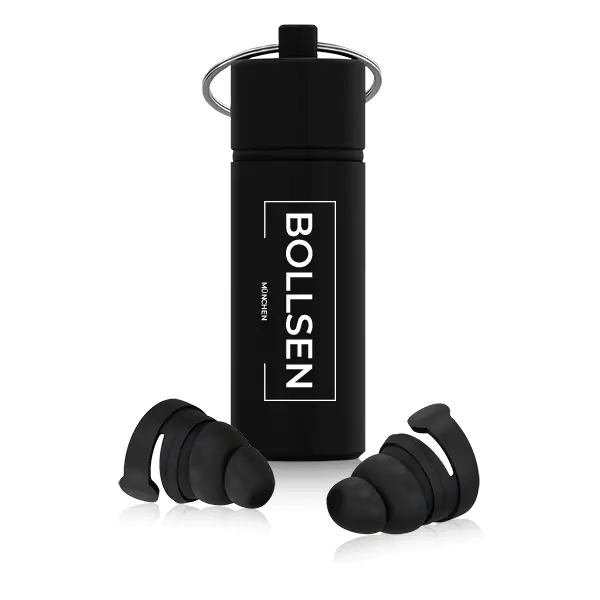
Wind buffeting at motorway speeds regularly exceeds 100 dB, louder than a chainsaw and draining over a long ride. Reusable motorcycle earplugs cut the wind roar so you arrive less worn out, without sealing you off from sirens and traffic. After testing across two seasons, our pick is the BOLLSEN Moto+.
At 70 mph, the air inside your helmet generates 95–105 dB, louder than a chainsaw. Most UK riders have no idea how much that roar wears them down on every single ride.
- 01Know the real noise level — wind roar builds up ride after ride
- 02The real culprit is wind, not your engine — and your helmet can’t fix it
- 03Skip foam — choose a reusable earplug built for riding
- 04The right earplugs preserve your situational awareness, not reduce it
- 05Get the fit right — a poor seal loses most of the protection
- 06Make it a reflex: every ride counts, not just the long ones
Know the real noise level — wind roar builds up ride after ride
Wind roar doesn’t announce itself. There’s no single loud moment, just a constant noise you stop noticing. But your brain works the whole time to filter it, which is why a long motorway run can leave you drained and slower to react by the time you pull in.
For motorcyclists, the numbers are stark. At 35 mph, wind noise under a helmet typically sits at 85–95 dB. At 65 mph it rises to 110–116 dB, far louder than a busy restaurant or a lawnmower. A standard hour on a dual carriageway at 70 mph is a solid block of that roar with nothing to break it up.
In the UK, the vast majority of motorcyclists ride with nothing in their ears. Many have never tried earplugs on a bike, or assume they’d block out traffic. Once you’ve ridden with the roar turned down, it’s hard to go back.
The real culprit is wind, not your engine — and your helmet can’t fix it
Here’s something most riders get wrong: the noise that drowns out everything else isn’t the engine, the exhaust, or even traffic. It’s the turbulent air that forms inside your helmet at speed. Wind buffeting is the dominant noise source for virtually all riders above 30 mph.
This matters because it changes how you think about protection. A quieter exhaust doesn’t help. A better-sealed helmet reduces the problem somewhat — aerodynamic designs and neck-sealing skirts make a genuine difference — but they don’t eliminate it. Wind turbulence inside the helmet stays loud even in premium lids. The fix isn’t the helmet; it’s what you put in your ears.
Your engine, by comparison, typically produces around 80–85 dB at the rider’s position — noticeable, but nothing like the wind. Wind noise at speed is the problem that needs solving.
Skip foam — choose a reusable earplug built for riding
The instinct many riders have — “I’ll just use those cheap foam ones from the chemist” — is understandable but flawed. Foam earplugs block the ear canal entirely, cutting all sound indiscriminately. You lose access to the sounds you need to hear: sirens, horns, your engine note, your intercom. This is why many riders avoid ear protection altogether, and it’s a reasonable concern given how foam works.
Good motorcycle earplugs work differently. They’re soft silicone that lowers the overall sound level by around 24 dB rather than plugging your ears completely. On a bike the biggest win is what they do to wind: at speed the constant wind roar is by far the loudest thing, and it drowns everything else out. Bring that roar down and the sounds that matter — sirens, horns, your engine note, your intercom — sit above it again, just at a safer volume. You get the wind roar turned right down without being sealed off from the road.
The specification to look for is a certified SNR or NRR of at least 22–24 dB, independently tested by a NANDO-listed notified body — not a manufacturer’s own figure.
The right earplugs preserve your situational awareness, not reduce it
Most riders who try a quality reusable plug for the first time report the same thing: at motorway speeds, wind noise creates a masking effect — it doesn’t just add noise, it drowns out other sounds, including the ones you need. A siren approaching from the side, a horn, a change in engine pitch signalling something’s wrong.
Bring the wind noise down with a good earplug, and you unmask those sounds. Riders who switch from foam or nothing to quality reusable plugs frequently report they can hear other vehicles more clearly, not less. Traffic sounds crisper. Engine feedback is easier to read. Heavy commuting is noticeably less fatiguing because your brain isn’t working overtime to filter the noise.
Foam plugs
- Muffles everything — harder to stay aware
- Pushed in deep, fiddly under a helmet
- Single-use, adds waste
BOLLSEN Moto+
- Cuts the wind roar that masks sirens
- Lowers volume without sealing you off
- Reusable up to 100 times
Get the fit right — a poor seal loses most of the protection
An earplug that isn’t seated correctly provides a fraction of its rated protection. Most SNR figures assume a proper acoustic seal. A loose fit can reduce effective attenuation from 24 dB to 6–8 dB — barely better than nothing.
For triple-flange silicone earplugs (ideal under a helmet because of their low profile), the insertion technique is simple but important. Pull the top of your ear upward and back to straighten the canal. Insert with a gentle rotating motion until all flanges are seated. You should feel a light occlusion, not discomfort. If you feel pain, the plug is too large for your canal. Try a smaller size.
Our pick — BOLLSEN Moto+ ✓ — uses a triple-flange design and is available with AR KI TECH AI sizing for a precision fit.
Make it a reflex: every ride counts, not just the long ones
The most common mistake is treating ear protection as something you only do on long rides. “I’m only popping to the shop — I’ll skip them this once.” It’s understandable, but it misses how cumulative exposure works.
At 60 mph, wind noise inside your helmet exceeds 100 dB for the full ride. Do that twice a day, five days a week, and you’re spending hours under the roar every week, particularly if you also ride at weekends. Short rides still add up.
The fix is simple: keep your earplugs with your helmet, not in a drawer. When inserting them becomes as automatic as putting on your gloves, you’ll do it on every ride without thinking. The whole process takes 30 seconds, and every ride is quieter for it.
Free UK delivery · 40-day money-back guarantee
BOLLSEN Moto+
- Soft silicone — cuts wind & road noise, SNR 24 dB
- Low-profile triple-flange — no pressure under any helmet
- Independently certified by PZT GmbH (Notified Body 1974)
- Reusable up to 100 times — aluminium travel case included
★★★★★“I’d been feeling mentally drained after anything over four hours — worn down by the constant wind noise. Moto+ made a noticeable difference on longer runs; the buffeting dulled right down and I was arriving feeling sharper.”
Charlotte Pemberton · Long-distance courier
★★★★★“Fantastic results — excellent sound suppression, supremely comfortable. Could hear my exhaust without the wind noise. I’m blown away.”
DC Crane · Verified buyer
★★★★★“I wear them while riding my motorcycle — cuts out the wind noise and protects my hearing.”
Sami Hulkko · Verified buyer
From 455 verified reviews of the BOLLSEN Moto+ · Read more →
Wind noise is the loudest thing a motorcyclist rides through, and it builds up over thousands of rides. A certified 24 dB earplug, worn on every ride and inserted correctly, turns the roar down without cutting you off from the road. It costs less than a tank of fuel, and every ride is calmer for it.