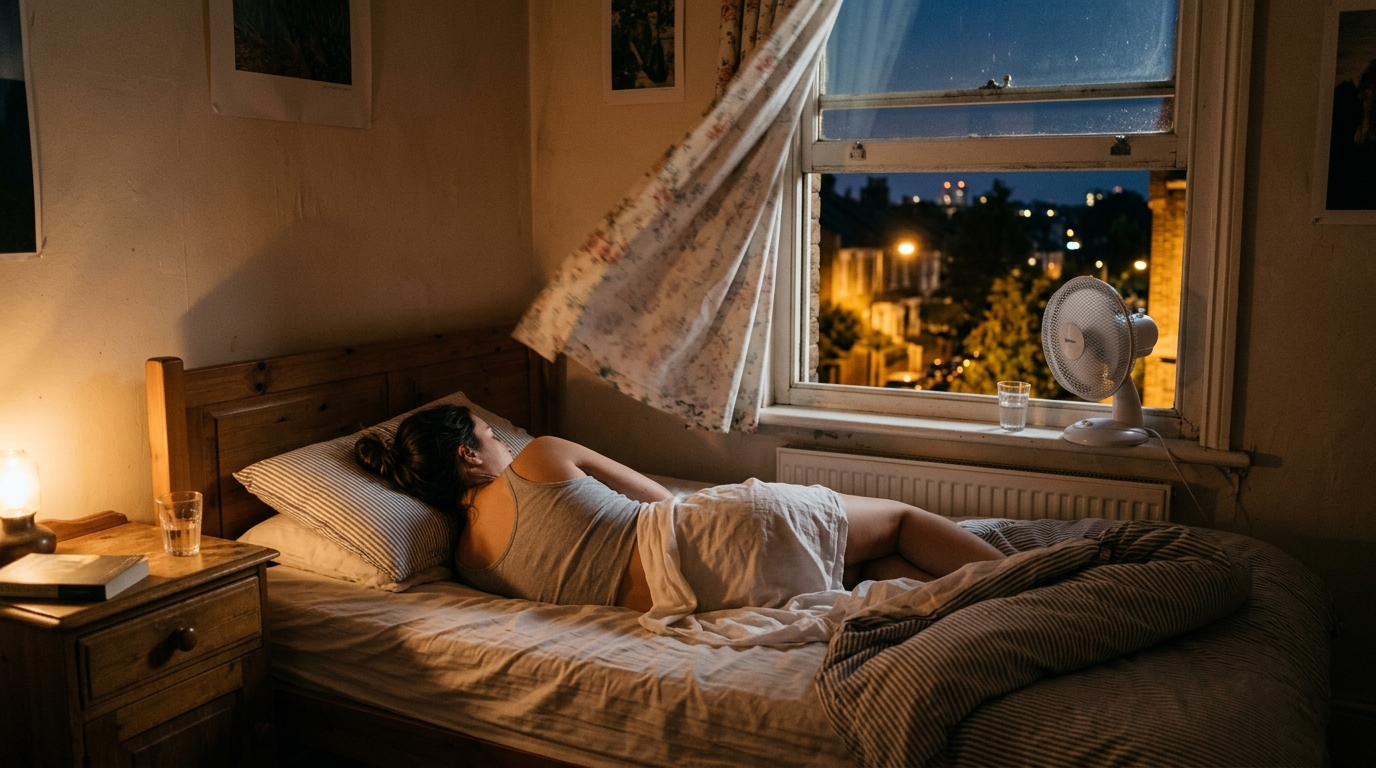
Your bedroom sits at 26°C and the only way to cool it down is the open window. So you open it, and in floods the 2am taxi rank, the night bus, next door’s air-con unit. Nobody warns you about that trap. Loughborough University researchers have shown that night-time ventilation is the single most effective way to cool a home without air conditioning, yet most of us slam the window shut within an hour because the noise is unbearable. Knowing how to sleep in a heatwave comes down to two problems at once: getting the heat out, and keeping the noise from following it in. Here is how to do both.
This guide draws on UK overheating research from Loughborough University and the British Red Cross, plus the certified noise-reduction figures behind the products we recommend. We focused on advice that works in a typical UK bedroom with no air conditioning.
[/ux_text] [/col] [/row] [/section] [section id=”product-1″ padding=”24px 0px 24px 0px” padding__sm=”16px 0px 16px 0px” bg_color=”rgb(245, 248, 255)”] [row v_align=”middle” h_align=”center”] [col span=”4″ span__sm=”12″ force_first=”small” align=”center”] [ux_image id=”4679″ image_size=”original” link=”https://bollsen-hearingprotection.com/product/life/” target=”_blank”] [/col] [col span=”8″ span__sm=”12″] [ux_text font_size=”1.1″]BOLLSEN Life+ Earplugs for Sleeping
★ Our Top Pick — best for sleeping with the window open
BOLLSEN is a hearing protection specialist whose products are independently tested and certified in Germany. The Life+ earplugs cut 24 dB of low-frequency noise, exactly the band that traffic rumble, snoring and air-con hum live in, while still letting higher-pitched sounds like your alarm and a smoke detector through. That is what makes them the right tool for an open window on a hot night: you get the airflow without surrendering your sleep to the street.
[/ux_text] [block id=”2889″] [ux_text font_size=”1.02″]- Certified 24 dB reduction, tuned to block low-frequency traffic and snoring
- Low-profile flush fit designed for side sleepers, no poking into the pillow
- Still lets you hear your alarm and smoke detector
- Reusable up to 100 times, washable, comes with a travel case
- Backed by a 40-day money-back guarantee
- Not the cheapest option upfront, though the per-night cost is tiny over 100 uses
1. Cool the room before bed, not after you’ve climbed in
The mistake most of us make is trying to cool down once we are already lying there sweating. By then the walls, the mattress and the air have all soaked up the day’s heat and you are fighting a losing battle. Start earlier. Keep windows, curtains and blinds shut through the hottest part of the afternoon to stop the sun baking the room, then throw everything open the moment the outside air drops below the inside temperature, usually well after sunset in a UK summer.
If you can create a cross-breeze by opening a window at each end of the flat, even better. Moving air carries heat out far faster than a single window ever will, and it is the closest thing to free air conditioning most of us have.
2. Open the window at night, then block the noise it lets in
Every heatwave guide tells you to open the window after dark, and they are right. Night ventilation is how a building sheds the heat it stored during the day. The part they skip is what happens next: traffic noise keeping you awake at night, a neighbour’s window unit droning on, the 5am refuse lorry. So you close the window, the room heats back up, and you are stuck choosing between cool and quiet.
You do not have to choose. A good pair of earplugs designed for sleeping lets you leave the window wide open and still drop off. This is exactly the situation the Life+ earplugs were built for. They knock down the low-frequency drone of traffic and air-con by 24 dB, the certified figure that BOLLSEN’s products are independently tested for in Germany, while leaving the higher frequencies your alarm sits in audible. You get the airflow and the silence, which is the whole point.
[/ux_text] [/col] [/row] [/section] [section bg_color=”rgb(0, 36, 125)” padding=”24px 0px 24px 0px”] [row h_align=”center”] [col span__sm=”12″ align=”center”] [ux_text font_size=”1.05″]Ready to sleep with the window open without the street keeping you up?
[/ux_text] [button text=”Try Risk-Free — 40-Day Guarantee” color=”secondary” style=”shade” size=”large” radius=”10″ link=”https://bollsen-hearingprotection.com/product/life/” target=”_blank”] [/col] [/row] [/section] [section padding=”30px 0px 10px 0px” padding__sm=”20px 0px 10px 0px”] [row h_align=”center”] [col span__sm=”12″] [ux_text font_size=”1.05″ line_height=”1.7″]3. Cool your body, not just the bedroom
Your core temperature has to drop a little for sleep to kick in, which is why you lie there wide awake when you are hot even though you are exhausted. Give it a hand. A lukewarm shower before bed pulls heat away as the water evaporates, and a damp flannel on the back of your neck, wrists or the inside of your elbows targets the spots where blood runs close to the skin.
Skip the freezing cold shower, tempting as it is. Very cold water tells your body to hold on to heat to protect itself, so you end up warmer once you towel off. Lukewarm is the sweet spot.
4. Swap your bedding for breathable layers
Heavy duvets and synthetic sheets trap heat against you all night. Switch to cotton or linen, which let air move and wick away sweat instead of sealing it in. If you normally sleep under a duvet, ditch the cover entirely on the worst nights and use a single flat sheet.
The freezer trick genuinely works too. Pop your pillowcase or top sheet into a sealed bag and leave it in the freezer for an hour before bed. It will not stay cold all night, but it buys you that crucial cool window while you fall asleep, which is often the hardest part on a hot night.
5. Set up airflow that keeps working after you’ve nodded off
A fan does two jobs on a hot night. It moves air across your skin so sweat can evaporate and cool you, and the steady whoosh masks the sharper, sleep-wrecking noises from outside, the door slams and the shouts that earplugs handle even better. Angle it across the bed rather than straight at your face, which can dry out your throat and leave you groggy.
For an extra few degrees, set a shallow bowl of ice or a couple of frozen water bottles in front of the fan. As the ice melts, the fan pushes genuinely cooler air your way. It is a low-effort hack that makes a real difference in a small bedroom.
6. Protect your sleep from the rest of the household and the street
Heat makes everyone restless, so even once your room is sorted you are still exposed to a partner tossing and turning, a snorer who gets louder in the warmth, and a street that never fully quietens in summer. This is where the open-window plan usually falls apart, and where the earplugs earn their place. Because the Life+ pair filters by frequency rather than just muffling everything, you stay cocooned from the low rumble while a smoke alarm or a child calling out still gets through.
Comfort matters when you are wearing them all night. The flush, low-profile fit means side sleepers can lie straight on their ear without anything digging in, and the medical-grade silicone is soft enough that you forget you have them in. Trusted by over 1,000,000 people and backed by more than 10,000 verified reviews, they fix the noise half of the heatwave problem for good.
7. Build a heatwave routine you can repeat all summer
UK heatwaves are no longer a one-off. Spring 2026 broke records and the summer is forecast to run hotter than average, so the smart move is to turn these steps into a routine rather than scrambling each time the temperature spikes. Pre-cool the room in the afternoon, ventilate hard after dark, cool your body before bed, and keep the window open with earplugs in.
Once the routine becomes second nature you stop dreading the forecast. The heat still comes, but it stops costing you sleep, which is the only part you can actually control.
[/ux_text] [/col] [/row] [/section] [divider margin=”0px”] [section padding=”30px 0px 30px 0px” padding__sm=”20px 0px 20px 0px”] [row h_align=”center”] [col span__sm=”12″] [ux_text font_size=”1.05″ line_height=”1.7″]Frequently Asked Questions
Should I sleep with my window open or closed in a heatwave?
Closed during the hot daytime hours to keep the sun’s heat out, then open at night once the outside air is cooler than your bedroom. Night ventilation is the most effective way to cool a home without air conditioning. The catch is the noise it lets in, which is why a pair of sleep earplugs makes the open-window approach actually liveable.
Why can’t I sleep when it’s hot, even when I’m exhausted?
Your body needs its core temperature to fall slightly to trigger sleep. When the room is too warm that drop cannot happen, so you stay alert no matter how tired you feel. Cooling your body with a lukewarm shower and getting airflow across the bed helps your temperature come down.
How do I cool my bedroom without air conditioning?
Block out daytime sun with closed curtains, ventilate at night with windows open at both ends for a cross-breeze, run a fan with a bowl of ice in front of it, and switch to breathable cotton or linen bedding. These steps together can take several degrees off a stuffy room.
Does sleeping with the window open let in too much noise?
It often does, which is the reason so many people give up on night ventilation and overheat instead. The fix is not to close the window but to block the noise at your ear. Earplugs designed for sleeping cut the low-frequency traffic and street noise that an open window lets in, so you keep the airflow and lose the disturbance.
Do earplugs work for blocking traffic and street noise at night?
Yes, when they are the right type. The Life+ earplugs are certified to reduce noise by 24 dB and are tuned to block low-frequency sounds like traffic rumble and snoring, which are the hardest to ignore at night. Foam plugs muffle everything indiscriminately, whereas these filter by frequency so useful sounds still come through.
Can I still hear my alarm or smoke alarm if I wear earplugs?
Yes. The Life+ design blocks low-frequency noise while letting higher-frequency sounds pass, so your alarm clock and smoke detector remain audible. You get protection from the street without being cut off from the sounds that matter.
[/ux_text] [/col] [/row] [/section] [section bg_color=”rgb(245, 248, 255)” padding=”24px 0px 24px 0px” padding__sm=”16px 0px 16px 0px”] [row h_align=”center”] [col span__sm=”12″] [ux_text]