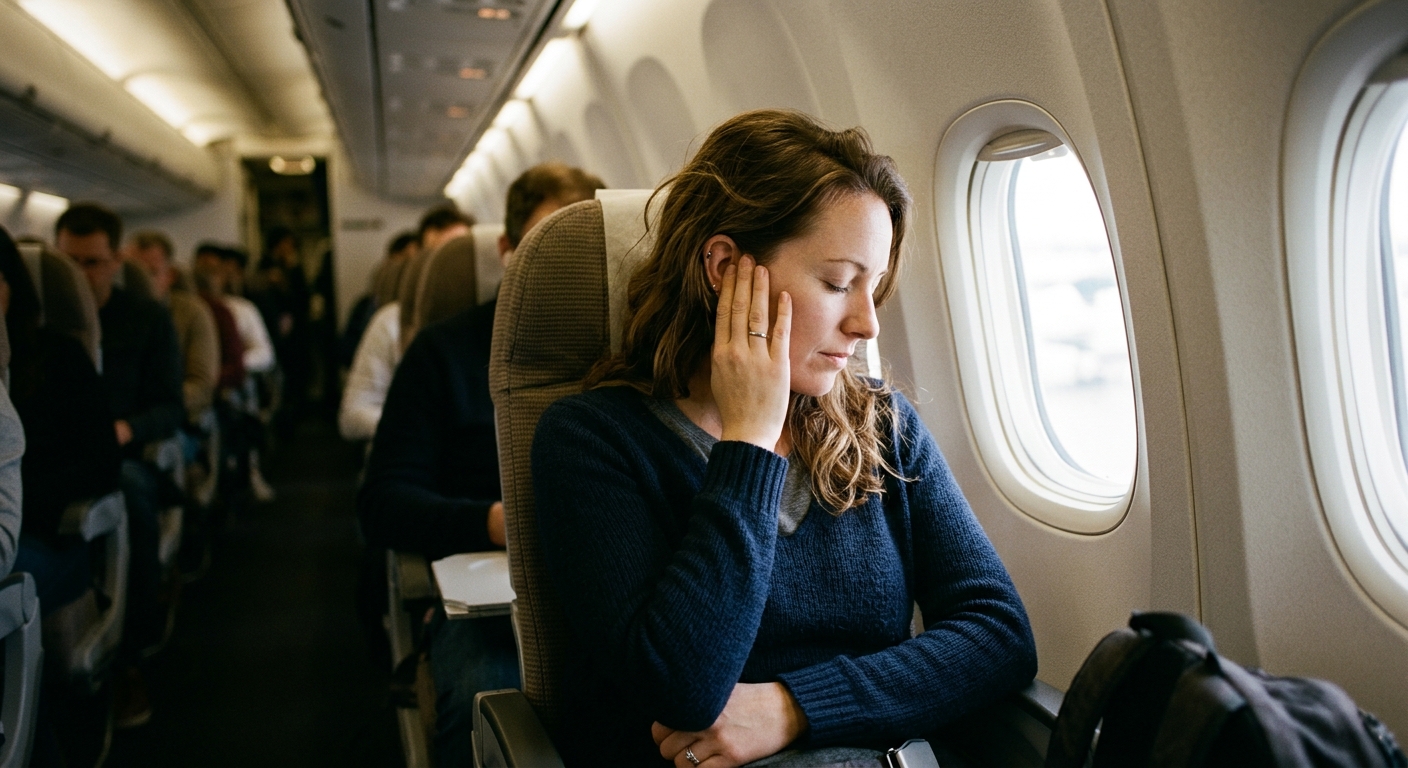
Around 85% of passengers experience some ear discomfort when flying. That tight, blocked feeling as the plane climbs or drops isn’t random. It’s a predictable physiological response to rapid pressure change, and for some people it can be genuinely painful. This guide breaks down what’s actually happening inside your ear, why descent hurts more than ascent, and what works to prevent it.
We reviewed the clinical evidence on ear barotrauma and looked at the available research on prevention strategies: filtered earplugs, the Valsalva manoeuvre, nasal decongestants, and what to do when none of it seems to help.
[/ux_text] [/col] [/row] [/section] [section id=”product-1″ padding=”24px 0px 24px 0px” padding__sm=”16px 0px 16px 0px” bg_color=”rgb(245, 248, 255)”] [row v_align=”middle” h_align=”center”] [col span=”4″ span__sm=”12″ force_first=”small” align=”center”] [ux_image id=”4637″ image_size=”original” link=”https://bollsen-hearingprotection.com/product/life/” target=”_blank”] [/col] [col span=”8″ span__sm=”12″] [ux_text font_size=”1.1″]BOLLSEN Life+ Earplugs
★ Our Top Pick — Best for ear pressure on planes
BOLLSEN is a hearing protection specialist whose products are independently tested and certified in Germany. The Life+ is a flat-filter earplug with certified 24 dB noise reduction. Unlike foam plugs that block all sound indiscriminately, it slows the rate of air pressure change reaching the eardrum, giving the eustachian tube a little extra time to equalise. Medical-grade silicone, reusable up to 100 times, and backed by a 40-day money-back guarantee.
[/ux_text] [block id=”2889″] [ux_text font_size=”1.02″]- Flat-filter design slows pressure change without blocking all sound
- 24 dB certified noise reduction (independently tested by PZT GmbH, Germany)
- Medical-grade silicone, BPA-free, latex-free, washable
- Low-profile flush fit, comfortable for long-haul flights
- 40-day money-back guarantee
- Not a substitute for medical treatment if you have an active ear infection
What actually happens to your ears on a plane
Your eardrum sits between the outer ear canal and the middle ear. The middle ear is a sealed, air-filled cavity connected to your nose and throat via the eustachian tube. On the ground, the pressure inside that cavity matches the pressure outside. No tension, no discomfort.
At cruising altitude, the cabin is pressurised to roughly the equivalent of 6,000–8,000 feet above sea level. That’s lower than sea-level pressure. As the plane climbs, the air inside your middle ear is at slightly higher pressure than the cabin, and the eustachian tube vents that excess naturally. Most people don’t notice it at all.
Descent is where things go wrong. As the plane drops and cabin pressure rises back toward sea level, the air outside your eardrum becomes denser than the air trapped inside the middle ear. The eardrum bows inward. On ascent, the eustachian tube opens passively. On descent, it needs active muscular assistance to open. If it stays closed, the pressure differential physically locks it shut. That’s why the pain peaks during landing, not takeoff.
Why do some people get ear pain flying more than others?
Anatomy matters. Some eustachian tubes are narrower or angled in ways that make them harder to open. Age is a factor too. Children have smaller, more horizontal eustachian tubes, which explains why so many kids on planes look visibly miserable during landing.
Any upper respiratory condition makes it substantially worse. A cold, hay fever, or nasal congestion narrows the eustachian tube opening. Board a flight with a blocked nose and equalising pressure during descent becomes a much harder problem.
Frequent flyers sometimes develop a kind of acquired tolerance, but that’s not the same as immunity. Repeated barotrauma can lead to fluid accumulation in the middle ear, temporary hearing loss, and in serious cases, a perforated eardrum.
How to stop ears hurting on a plane: five approaches that actually work
1. Swallow and yawn frequently, especially during descent
Both actions activate the muscles that open the eustachian tube. Swallowing can equalise a small pressure differential before it builds to the point of pain. Chewing gum achieves the same thing. No equipment required. Make it a habit as soon as you feel the descent begin.
2. Use the Valsalva manoeuvre if pressure builds
Pinch your nostrils, close your mouth, and gently exhale as though blowing your nose. The goal is to push air up into the eustachian tube to re-equalise the middle ear. It works for most people. The critical word is gently. Too much force can cause its own problems. If it doesn’t work, try the Toynbee manoeuvre: pinch your nose and swallow at the same time.
3. Wear filtered earplugs from takeoff through the full descent
Most travellers skip this entirely, or grab a pair of foam plugs and wonder why it doesn’t help. Flat-filter earplugs work on a different principle. Instead of sealing the ear canal, they use a small acoustic filter to slow the rate of air pressure change reaching the eardrum. That gives your eustachian tube more time to respond to each incremental pressure shift, rather than being hit with a rapid change it can’t match.
The BOLLSEN Life+ uses exactly this mechanism. Put them in before the doors close and keep them in until you’re inside the terminal. Taking them out mid-descent defeats the purpose. Over 10,000 verified reviews support this approach, and independent certification from PZT GmbH in Germany confirms the 24 dB filter performance. That’s not a marketing claim. It’s a tested result.
4. Consider a nasal decongestant if you’re flying with a cold
A pharmacist-recommended decongestant taken 30–45 minutes before descent can reduce swelling in the nasal passages and eustachian tube lining. Useful if you have a cold, hay fever, or sinusitis. It won’t fix everything, and some people get rebound congestion once it wears off, so use it when it’s genuinely warranted rather than on every trip.
5. Stay awake during descent
When you’re asleep, swallowing drops to almost nothing and you stop yawning entirely. Active equalisation becomes impossible. A lot of the worst cases of airplane ear happen on overnight flights where passengers sleep right through the descent. Set a quiet alarm or ask cabin crew to wake you 30 minutes before landing. Most people only think of this after it’s too late.
Earplugs for flying: foam versus flat-filter
Standard foam earplugs are built to block as much noise as possible. Fine for sleeping or industrial environments, but on a plane they create a sealed air column in the outer ear canal. That does nothing for middle ear pressure. You’ll just have a harder time hearing the announcements while your ears still hurt.
Flat-filter earplugs are built differently. Air passes through at a controlled rate. The filter slows pressure transients without sealing the canal. On a quiet flight, you’ll still hear conversation. You just won’t feel the full brunt of the pressure shift at the speed the aircraft’s descent creates it.
If you fly more than twice a year, a pair of reusable flat-filter plugs is a sensible investment. Foam is single-use and uncomfortable for extended wear. It doesn’t address barotrauma at all. The BOLLSEN Life+ is £26.95 and rated for up to 100 uses, which works out to under 27p per use.
[/ux_text] [/col] [/row] [/section] [section bg_color=”rgb(0, 36, 125)” padding=”24px 0px 24px 0px”] [row h_align=”center”] [col span__sm=”12″ align=”center”] [ux_text font_size=”1.05″]Ready to take the sting out of your next flight?
[/ux_text] [button text=”Try Risk-Free — 40-Day Guarantee” color=”secondary” style=”shade” size=”large” radius=”10″ link=”https://bollsen-hearingprotection.com/product/life/” target=”_blank”] [/col] [/row] [/section] [divider margin=”0px”] [section padding=”30px 0px 30px 0px” padding__sm=”20px 0px 20px 0px”] [row h_align=”center”] [col span__sm=”12″] [ux_text font_size=”1.05″ line_height=”1.7″]Frequently Asked Questions
Why do your ears hurt on a plane?
Cabin pressure changes during ascent and descent, and the air inside your middle ear has to equalise with it. If the eustachian tube (the small canal connecting the middle ear to the back of the nose) can’t open quickly enough, the pressure difference puts strain on the eardrum. That’s the blocked, painful feeling. Descent is usually worse because the eustachian tube needs active muscular effort to open in that direction, not just passive venting.
How do you stop ear pain when flying?
A combination of things: swallow frequently and chew gum during descent, use the Valsalva manoeuvre (gently pinch your nose and exhale) when pressure builds, wear flat-filter earplugs that slow the rate of pressure change, and stay awake during the descent so you’re actively equalising. No single fix works perfectly on its own.
Why is it worse during landing than takeoff?
During ascent, the eustachian tube vents excess pressure on its own. During descent, as cabin pressure rises back toward sea level, you need to actively open the tube to let higher-pressure air in. Leave it too long and a negative pressure builds behind the eardrum that physically holds the tube shut. The longer you wait, the harder it is to equalise.
Do earplugs help with ear pressure on planes?
Foam earplugs don’t. Flat-filter earplugs do. The filter slows the rate of pressure change reaching the eardrum, giving your eustachian tube more time to respond. They buffer pressure rather than block it entirely. The BOLLSEN Life+ is one of the few options with independently certified filter performance (24 dB, PZT GmbH, Germany).
How long does airplane ear last?
Mild cases usually sort themselves out within a few hours as the eustachian tube equalises naturally. More significant barotrauma (where fluid accumulates in the middle ear) can cause muffled hearing or a persistent blocked feeling for several days. If symptoms haven’t cleared after two or three days, see a GP or pharmacist.
Can flying damage your hearing?
Pressure alone is unlikely to cause permanent damage on occasional flights. But repeated severe barotrauma can leave scar tissue on the eardrum, and cabin noise on a long-haul flight typically runs at 80–85 dB, which is enough to cause cumulative hearing fatigue over multiple exposures. Filtered earplugs help on both fronts: they buffer pressure changes and reduce sustained noise exposure.
What should I do if my ears stay blocked after flying?
Steam inhalation, a nasal saline rinse, or a decongestant can help reduce swelling in the eustachian tube. Avoid further flying, diving, or anything involving rapid pressure change until symptoms clear. If the blockage hasn’t resolved after three days, see a GP to rule out fluid in the middle ear or a perforated eardrum.
Is it safe to fly with an ear infection?
Depends on the type. An outer ear infection (swimmer’s ear) doesn’t affect the eustachian tube, so flying is generally fine. A middle ear infection is different. The eardrum is already under stress and pressure equalisation becomes harder. If there’s any uncertainty, check with a GP before you fly, especially if you’ve had a perforated eardrum before.
Why do children’s ears hurt more on planes?
Children have smaller, more horizontal eustachian tubes, which are harder to open actively during descent. They also haven’t learned the equalisation techniques adults use instinctively. Getting children to drink through a straw, blow bubbles through a straw, or chew during descent can help. For younger children who can’t manage that, feeding or a dummy during descent tends to work by keeping them swallowing.
Does the Valsalva manoeuvre actually work?
For most people, yes. Pinch your nostrils, close your mouth, and gently exhale. Gently is the key. The aim is to push enough air into the eustachian tube to equalise, not to force it under pressure. If that doesn’t work, try the Toynbee manoeuvre: pinch your nose and swallow at the same time. If neither works and you’re in significant pain, tell the cabin crew.
[/ux_text] [/col] [/row] [/section] [section bg_color=”rgb(245, 248, 255)” padding=”24px 0px 24px 0px” padding__sm=”16px 0px 16px 0px”] [row h_align=”center”] [col span__sm=”12″] [ux_text]